How Mature Is Your ITAM Practice Really?
When the annual software audit letter landed in their inbox, the leadership team at a mid-sized organisation thought they were ready. They had tools in place, some policies written years ago, and a handful of spreadsheets tracking key vendors. On paper, it looked like IT Asset Management was “covered”.
Then the true picture emerged. The data coming from different tools did not match. Procurement, IT, and Finance each had their own version of the truth. Hardware was being disposed of without anyone checking for sensitive data. A few legacy contracts hid expensive compliance risks in the small print. And suddenly, what had looked like a routine audit had become a material business risk.
This is what an immature ITAM practice feels like: busy, reactive, and fragile. And it is precisely the kind of situation the ITAM Maturity Assessment is designed to surface before it becomes urgent.
Why ITAM maturity is more than “having a tool”
Many organisations equate ITAM maturity with simply owning a SAM tool or having a CMDB in place. But maturity is not about whether a tool exists. It is about how your organisation governs, controls, finances, and operationalises IT assets using that toolset.
The assessment behind the ITAM Maturity model evaluates your practices across a series of dimensions that mirror how real organisations operate. Governance encompasses having a clear strategy, executive sponsorship, and a roadmap for ITAM improvement. It asks whether ITAM is anchored in policy and aligned with the broader technology and organisational strategy.
- Control then examines how that intent plays out on the ground. Are there KPIs and critical success factors for ITAM processes? Are they measured regularly? Is there a clear response when something fails or a process drifts from standard? This is where you find out whether your Plan, Do, Check, Act cycle is real or just an idea on a slide.
- Financial management looks at the money. How well do you understand your IT asset spend? Can you show cost savings and cost avoidance coming from ITAM decisions? Do you set and track savings targets, or does optimisation only happen reactively when budgets get cut? For organisations operating under tight margins or public scrutiny, this dimension often becomes the board’s main concern.
- Data and systems is where many “we thought we were fine” stories begin. It is not about whether you use one brand of SAM tool or another. It is about whether your tools are properly integrated, whether the data is trusted, and whether discrepancies are treated as a priority. Highly mature organisations build a virtuous cycle of trustworthy data: exceptions are investigated, fixed, and fed back into the process so the data keeps getting better.
- Finally, HAM and SAM lifecycle focuses on the everyday processes that move assets through their lifecycle. Procurement, catalogues, deployment, refresh, and disposal all have an ITAM impact, even when they are owned by other teams. And processes directly owned by ITAM, like license compliance or hardware disposal, often determine whether ITAM is perceived as a strategic function or as a cost centre that occasionally blocks projects.
Under the hood: a structured maturity and capability model
Behind the simple questionnaire is a structured view of process maturity and capability distilled into clear levels. Rather than just flagging “good” or “bad”, the model shows where each process sits on a scale from ad hoc to optimised, and how capable it is of delivering reliable outcomes.
That means you do not just see that, for example, your governance is weak. You see whether you are still in a reactive, personality-driven mode or whether you already have documented plans that simply are not being measured and refined. You do not just find out that your data is unreliable; you see whether the issue is missing integration, a lack of ownership, or the absence of a control loop that fixes data quality instead of working around it.
Because each question in the assessment is mapped back to specific processes under each dimension, your results point directly to where change is needed. And because the scoring model is consistent, you can agree on a target maturity level with senior management and then use future assessments to show progress against that target.
Turning insight into action
Imagine running the ITAM Maturity Assessment and discovering that you have relatively strong financial management but weak governance and control. That tells a clear story: your team is good at finding savings and avoiding waste, but there is no long-term strategy, and improvements rely heavily on heroic effort rather than predictable processes.
Or perhaps your data and systems score is high, but your HAM and SAM lifecycle is lagging. You have tools, discovery, and inventory in good shape, but procurement, deployment, refresh, or disposal practices are not aligned with ITAM outcomes. In that scenario, the action is not “buy another tool”; it is to embed ITAM into those lifecycle processes and use your existing data more intelligently.
This is the difference between a vague sense that “ITAM could be better” and a concrete, board-ready improvement plan.
Why now is the right time to measure your ITAM maturity
If you figured out the why, you know the pressure on ITAM is increasing from all sides: SaaS sprawl, complex hybrid licensing, security and compliance obligations, sustainability expectations, and constant budget scrutiny. In that environment, hoping that current practices are “good enough” is risky.
A structured ITAM maturity assessment gives you:
- A shared language with stakeholders about where you are and where you need to be.
- A way to prioritise improvements based on risk, cost, and strategic drivers instead of gut feel.
- A repeatable way to demonstrate progress and justify further investment in ITAM.
Where to start
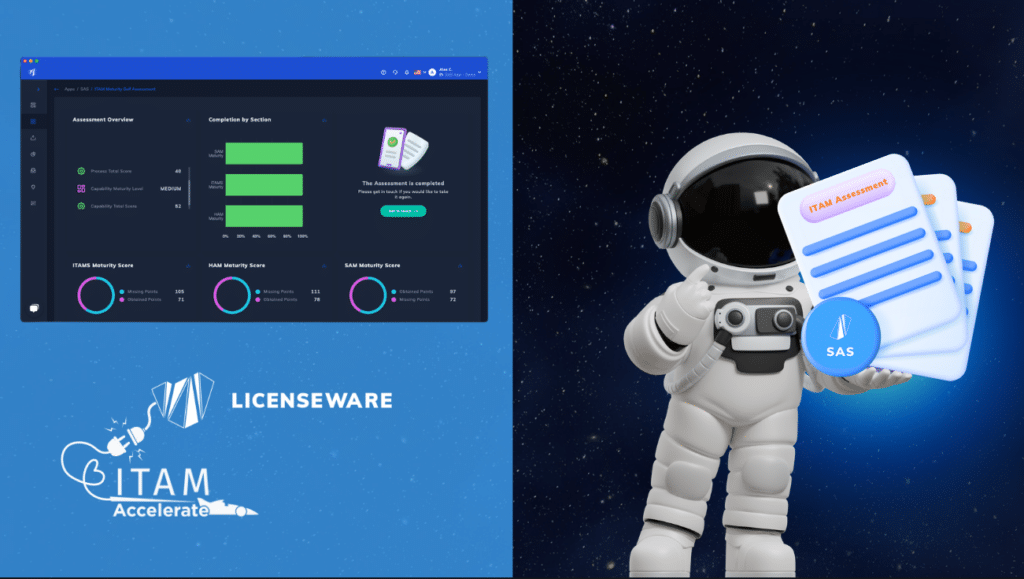
You can start by taking the ITAM Maturity Assessment and getting your baseline view. It is designed to be straightforward to complete while still giving a nuanced picture of governance, control, financial management, data and systems, and lifecycle processes.
From there, you can use the results to open a more strategic conversation with senior management about the level of maturity your organisation actually needs, and what it will take to get there.
To dive deeper into why measuring ITAM maturity matters and how it can transform the way you manage software and hardware assets, you can read more at:
👉 https://licenseware.io/why-should-i-measure-my-itam-maturity/