Microsoft’s Annual FX Write Locks Your Local Cloud List

Microsoft will now write commercial-cloud local-currency prices once a year, on 1 January, instead of twice a year. The first annual write is 1 January 2027. Local bills stay pegged to the dollar price. Microsoft will issue November advance guidance, and it keeps the right to move again in “limited exceptional circumstances.” Product-specific and consumer prices can still change on their own calendar. If your currency is weak against the dollar on 1 January, that local list is your bill for a year.
That’s the problem.
This is not a predictability story. It is a list-price mechanism. Microsoft is not changing what you consume. It is changing how often the dollar-to-local conversion gets written into the catalog you buy from. Fewer revision dates is not a quieter invoice. It is a longer lock on whichever side of the exchange rate you woke up on.
What Partner Center actually announced
The 8 July 2026 Partner Center note is the primary source. Beginning FY27 (1 July 2026), Microsoft transitions to annual local-currency pricing updates every January for Commercial Cloud services. The next update is effective 1 January 2027, “except in limited exceptional circumstances.” Notifications with guidance on the coming year’s pricing will be issued every November. Detailed guidance for the January 2027 update lands in November 2026.
Microsoft’s line is “greater pricing predictability while continuing to account for sustained fluctuations in foreign exchange rates.”
Read that sentence from your side of the table. Predictability for the seller’s dollar revenue is not the same as predictability for your local budget. If 1 January lands when your local currency is weak against the dollar, you get a high local bill for twelve months. The old semi-annual calendar gave you more price events, and a second chance for the rate to move your way.
Two more facts, easy to flatten into one story. Microsoft still sells fixed-price multi-year deals as the predictability product. Other product prices (and any consumer price adjustments) “will continue to be communicated separately.” The annual FX calendar is a date for commercial-cloud local list, not a freeze on Microsoft.
Microsoft annual FX prices are a list-price mechanism
You are not trading currency. Microsoft is writing a local list from a dollar peg.
That is the SAM point, and it is the FinOps point. A cost dashboard will keep showing consumption and unit rates in the currency you pay. It will not tell you which of those rates are about to be rewritten on 1 January, which sit on a multi-year fixed deal, and which belong to other products that can move on any Wednesday. Consumption is not a license position. Neither is a rate card, until someone recasts the estate against the agreement you hold.
The old twice-yearly revision was not kind. It was frequent. Two dates meant two chances for the rate to lift the local list, and two chances for it to pull back. One date means the 1 January snapshot does more work. If it is against you, you live with it unless Microsoft calls the circumstances exceptional (a threshold it has not defined).
Do not let Microsoft frame this as whether you want more predictability. The right question is narrower: which commercial-cloud SKUs take the 1 January local list, what are you using, and what sits on a term that is supposed to hold the price.
This is not a criticism of the teams watching Azure cost and Microsoft 365 seats in two different tools. Traditional SAM collects comprehensively and answers slowly. FinOps answers consumption quickly and licensing slowly. Neither was built to recast an estate against a November FX note before Finance closes the year. The gap is interpretation work. An analysis that arrives in February is a document. One that arrives while November guidance is still open is a decision input.
If that feels familiar, the problem is not your team’s maturity. A commercial question is being answered with a currency headline.
The November guidance window is the decision window
Picture your procurement director in the third week of November. Microsoft has published the currency guidance. Your CIO wants to know what 1 January does to the commercial-cloud line you pay in local currency. Finance wants a range for the year they are about to lock. Microsoft, or the partner who sells the next term, will walk in with a local list that already assumes the new rate.
If SAM needs three weeks to turn “what we consume” into “what the 1 January list does to the agreement we hold,” the window is already gone. You will spend December explaining last year’s consumption instead of deciding whether to take a multi-year conversation, or whether licensing is being offered as the price of a quieter bill.
A multi-year fixed-price cloud deal is one product. Tying licensing into that deal is another. You need to know whether the number on the table is cloud, licensing, or both, and whether your file can separate them.
November is guidance. 1 January is the write. Other products can still move in the months between, and after. Treat the annual FX calendar as a date for commercial-cloud local list, not as a freeze on Microsoft.
What to model before 1 January
Do this in the November window, as a decision pack, not a project.
| What to model | Why it has to be ready when November guidance lands |
|---|---|
| Commercial-cloud SKUs you pay in local currency | The annual revision applies to commercial cloud, not every Microsoft line. If you cannot split them, you will brief the wrong number. |
| What you actually consume vs what you are entitled to | A higher local list on unused seats is a silent uplift. A higher list on a workload you were already exiting is a different decision. |
| Which spend sits on list vs a multi-year fixed-price term | Fixed-price deals are how Microsoft and other public clouds sell predictability. Know which lines are already held. |
| Whether licensing is being pulled into the cloud conversation | A consumption-only file cannot answer a bundled offer. |
| Other Microsoft products that can still change at any time | Partner Center said product-specific and consumer adjustments stay on their own calendar. The annual write is not a price holiday. |
Then say, in one page, whether 1 January is a list-price event you absorb, a reason to reopen a term, or a reason to refuse a licensing tie-in. Volume discounts are already gone. The FX write is a second list-price event on the same estate. A currency note that arrives without that page is a document. A live position you can brief in fifteen minutes is a decision input.
Do not invent a percentage and call it a forecast. Partner Center did not publish one. Neither will this post. The mechanism is the story. Your job is the estate the snapshot will land on.
Can a non-specialist walk the CIO through that pack today? If the answer is no, you do not have a Microsoft annual FX position. You have a rate card and a waiting period.
The decision layer, not another FX spreadsheet
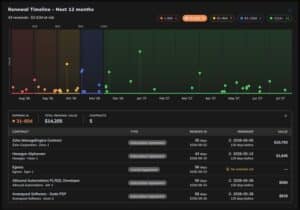
You already have consumption data, a Microsoft agreement, and a finance view of local spend. The LCM renewal timeline is which term is already held before 1 January lands. The gap is not another inventory. The gap is turning that estate into a decision: which commercial-cloud lines take the 1 January local list, what you are using, what is already on a term, and what should happen in November. LICENSEWARE sits on the inventory and ITSM tools you already run. It is not a rip-and-replace SAM suite. It is a decision layer: what matters, why it matters now, what should happen next. Microsoft Deployment Manager is the pack that recasts those commercial-cloud lines against the local list.
If November guidance is coming and your current tools still need three weeks to turn local-currency spend into a cloud-versus-licensing number, book a Software Intelligence Review. You can also start on the free plan and run the analysis on your own data.
The question to walk in with
Do not let Microsoft frame this as greater pricing predictability. The right question is: which commercial-cloud SKUs take the 1 January local list, what are we actually using, what is already held on a multi-year term, and is licensing being offered as the price of a quieter bill. That is a data question, not a sales question.
A weak currency on 1 January locks a high local list for a year. A strong one locks the other way. Other products can still move whenever Microsoft announces them. The vendor will walk in with a number. The only question is whether you have yours first: current, defensible, and tied to the contract in front of you.