
What a Mercadona Taught Us About Scaling a Software Company
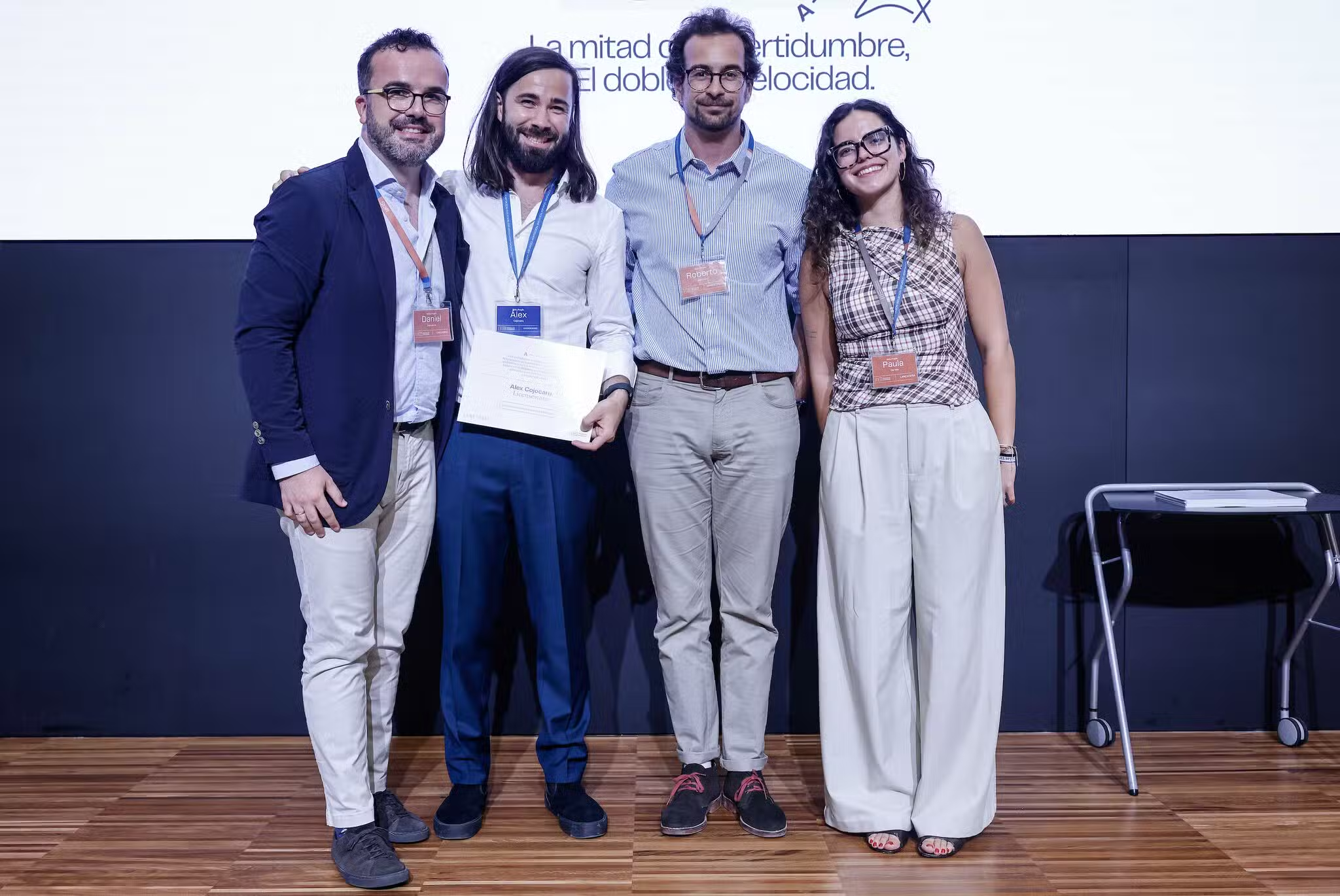
Five months ago LICENSEWARE walked into Lanzadera with big ambitions and a lot to prove. We have now closed the chapter on the acceleration program, and we are continuing into the 2.0 Program.
The obvious thing to write here would be a thank you note. Lanzadera deserves one, and it is at the end of this post. But the more useful thing to write about is what we are taking with us, because it did not come from a software company. It came from a supermarket, and we have adopted it as our governance and operating model.
The bet that nobody would make today
In 1990, Mercadona turned over roughly €763M and made under €15M of profit. The following year, turnover rose to about €877M and profit fell to under €6M.
Read those two numbers together. Selling more. Earning less. Losing ground to the foreign hypermarket chains while beating them at volume. There were buyout offers on the table, and taking one would have been the reasonable decision.
In 1993, Juan Roig did something else. He adopted the Total Quality Model and broke with the entire sector at once:
- Always Low Prices, replacing the high-low promotional pricing everyone else ran
- All advertising stopped, overnight
- Every special offer cancelled
- A commitment to customers to always sell at the same price
- A commitment to suppliers to stay loyal, at stable prices, for years
Price stability, supplier stability, employee stability, in service of one goal: permanent customers rather than promotional ones.
The first results were bad. Over the following four years, sales nearly doubled while profits fell by more than half. Roig held the line anyway.
From 1995, it turned. By 2007 Mercadona was running more than 1,100 supermarkets with over 60,000 employees and €336M in net profit, having grown turnover nine-fold in a decade at an average of 21.3% a year, the second fastest-growing food distributor in the world after Walmart. Today it is Spain’s leading retailer with more than 100,000 employees.
That is why the model is worth paying attention to. It was not a branding exercise or a values page written after the fact. It was a bet-the-company decision made from a position of weakness, held through four years of results that argued against it.
The model
The Total Quality Model asks a company to satisfy five components, equally and with the same intensity:
| Component | How Mercadona frames it |
|---|---|
| The customer | Known internally as “The Boss”, at the centre of every corporate decision |
| The employee | Satisfied through stability, training and internal promotion |
| The supplier | Long-term partners, not vendors to be squeezed |
| Society | Contribution to development and progress, responsibly and sustainably |
| Capital | Profit, which always comes after satisfying the rest |
The order is the whole point. This is not a stakeholder wheel where everything matters equally and therefore nothing does. It is a sequence. You satisfy the customer, which requires satisfying the employee, which requires working properly with suppliers, which requires operating responsibly in society. Capital is the result of doing those four things, not the input that governs them.
Why Lanzadera teaches it
Juan Roig founded Lanzadera in 2013 and finances it entirely himself. It takes no equity. It sits in Valencia’s Marina de Empresas alongside the EDEM business school and the investment company Angels, and it runs its acceleration method on the same Total Quality Model that Mercadona has used since 1993.
His stated reason for giving the model away is that knowledge and money bring happiness only if you share them.
For a startup, that means six months of structure, a diagnostic, a personalised roadmap, mentoring, and a floor full of founders who are all further along than you in something. It also means being taught a management framework by the person who bet a company on it.
The model is universal, which is the point
The same five components run a supermarket chain, a rocket company or a software company. That generality is not a weakness of the framework. It is the argument for it. A model that only works for one kind of business is not much of a model.
What changes is the configuration. We have documented ours internally as the single source of truth for how we make decisions, how we treat each component, how we run processes, and how we measure ourselves. Here is the short version.
The customer. Every pricing and product decision gets tested against one question: does this make the customer better off, or does it make our revenue more predictable at their expense? Those are often the same decision seen from two sides, and the model is unambiguous about which side wins.
The employee. We are distributed across Romania, Spain and the UK. Stability and training are not perks in that structure, they are the only things holding it together. People who feel secure make better long-term decisions than people who feel temporary.
The supplier. For us this maps to partners: resellers, managed service providers, and the consultancies delivering SAM services on the platform. Mercadona’s suppliers commit capital and R&D alongside the business because the relationship is stable enough to justify it. A partner program built on that premise looks nothing like one built on margin extraction.
Society. This is why we publish research openly rather than gating it. When we analysed what we keep finding in enterprise software estates, the findings went on the blog with the bases stated, not behind a form. The ITAM profession gets better when the data is shared.
Capital. We closed a seed round led by BCR Seed Starter earlier this year. Taking investment and putting capital last in the sequence are not in tension. Capital is what lets you serve the other four components at scale. It stops working the moment those four start serving it.
Why this lands hard in software asset management
Here is why the model hit us the way it did.
The SAM category has historically been built in the exact reverse order. Capital first.
That shows up as multi-year contracts that lock a customer in before value is proven. Pricing that is impossible to understand until you are three calls deep. Mandatory professional services attached to tools that should work without them. Renewal conversations where the vendor’s leverage comes from how hard it would be to leave rather than from how much the customer got.
Every one of those optimizes for capital first and asks the customer to absorb the consequence. It is the software equivalent of high-low promotional pricing: it works, right up until someone offers permanent value instead of a good quarter.
We built LICENSEWARE the other way round because it seemed obviously correct, not because we had a framework for it. The free plan exists so you can see whether the platform works on your data before anyone discusses money. Pay as you go exists so a one-off analysis costs what a one-off analysis should cost. NEO is free on every plan with no feature restrictions, because charging separately for the layer that makes the rest usable would be charging twice. We integrate with the inventory and ITSM tools you already run instead of asking you to replace them.
What the Total Quality Model gave us is the language and the discipline for something we were already doing by instinct. That matters more than it sounds, because instinct does not survive scale. Frameworks do.
What got us here will not get us there

The lesson underneath all of this is simpler and less comfortable.
We are maturing as a company, and what got us to this stage will not get us to the next one. The scrappiness that builds a product does not scale a business. The instinct that made early decisions correct does not survive contact with a team that has to make those decisions without you in the room.
That is what a framework is for. Not to replace judgment, but to make judgment repeatable when more people are making calls than any founder can personally supervise.
Roig held a line for four years while the numbers argued against him, because the model told him the numbers were measuring the wrong thing. That is only possible if the model is written down before the pressure arrives. Ours now is.
Thank you
To Lanzadera and everyone behind it: what you have built is genuinely unusual, and we hope it expands further. The team, the model, the founders around us, the whole ecosystem that makes the place work.
To the mentors who inspired, challenged and supported us through the program: you asked the hard questions and kept us honest. That kind of mentorship is rare and we did not take it for granted.
This is not goodbye. We are continuing in the 2.0 Program. Lanzadera is home for us here in Valencia, and we are just getting started.

If you want to see what customer-first looks like as a product rather than a philosophy, start on the free plan or book a demo. If you want to help us build it, we are hiring.


