
Why Your VMware CSP Invoice Is Not the Renewal Path
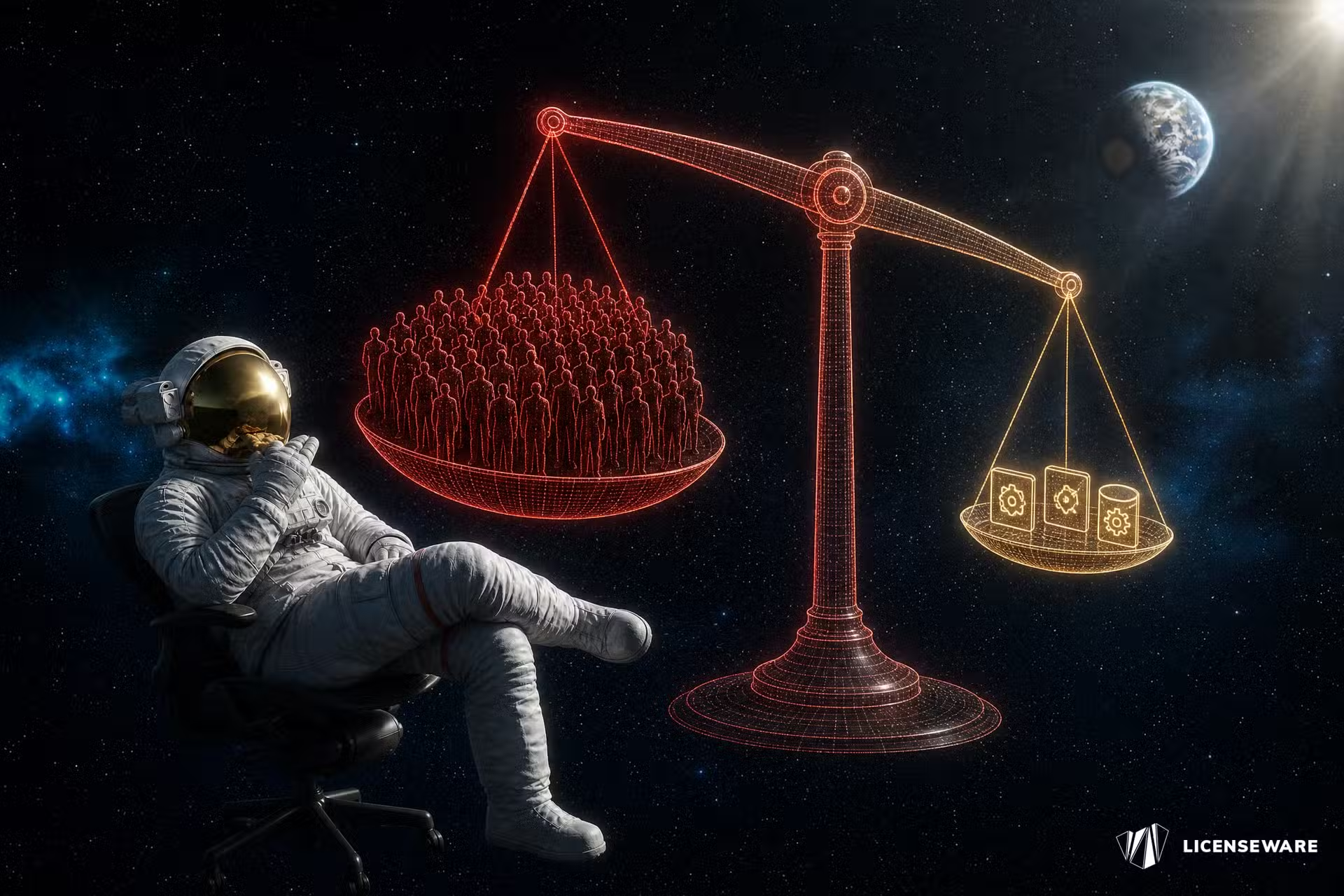
Broadcom closed the Advantage Partner Program for VMware Cloud Service Providers for most partners. CISPE says Broadcom signalled that termination in Europe in January 2026 and removed all but a tiny minority of hand-selected partners. Existing terms can still be serviced. New aggregates and commitment renewals are not a path you should assume. Treat any published close-out date as a reported channel date until you have the notice in writing for your seller.
That’s the problem.
The parent pack is the VMware Broadcom stay vs exit page: perpetual versus VCF, the support path, portable VCF on AVS, and third-party cover.
This is not a channel memo you can leave with your CSP. It is a supplier-list problem. If your hosted VMware spend still sits on a partner who was not retained, the next conversation is not a routine renewal. It is who is still authorized to sell you the product, on what paper, and whether the only remaining door is VMware Cloud Foundation through a narrower invite-only set.
The program closed. Your estate did not.
The direction was already on Broadcom’s own paper. In March 2024 Broadcom redefined the VCSP program around VMware Cloud Foundation, per-core subscription, three partner tiers, and a Cloud Commerce Manager. The same post was explicit: “Reducing the overall size of the VCSP program will ensure we have the right partners.” White Label was the on-ramp for providers who could not meet the new criteria. That on-ramp was later retired in the European Economic Area.
CISPE’s 19 March 2026 complaint to the European Commission is the public record of what January 2026 did to that structure. CISPE says Broadcom “signaled the termination of its VMware Cloud Service Provider program in Europe,” removing “all but a tiny minority of hand selected partners” and excluding most European CSPs from selling VMware products. It asked for interim measures: suspend the termination, readmit European providers, and reintroduce White Label.
Broadcom’s reply, given to CRN, is that it “strongly disagrees with the allegations by CISPE, an organization funded by hyperscalers, which misrepresent the realities of the market,” and that it continues to invest in European VCSP partners as an alternative to the hyperscalers.
You do not need to pick a side. You need to know whether your seller is still in that focused set.
Coterminous is not a new commitment
Read the January notice the way a procurement lead has to read it.
Partners could continue to transact new and existing coterminous customer opportunities through the end of the current commitment contract term. New contracts had to be coterminous with a current active commitment. They could not execute any new aggregate commitment contracts, nor any renewals for existing commitment contracts, so the program could wind down at the end of those terms.
Three acts, not one. Existing customers can be serviced through the remainder of the term (with Broadcom, a Cloud Commerce Manager, or a Primary White Label Provider, while that structure lasted). A new contract ending on the same date as the partner’s Broadcom commitment was allowed while the window was open. A new aggregate, or a renewal of the commitment itself, is not.
If your file still says “our CSP can renew us,” you are reading a reporting layer. Keeping the lights on is not the same as extending the relationship.
A reported close-out window is not a grace period for new commitments. If you locked a coterminous deal, you have a term to manage against the partner’s remaining commitment. If you did not, existing contracts run to term. The next paper is not a renewal of the old program.
Who can still sell you VMware
Picture your procurement director, sixty days from a VMware conversation. The invoice still comes from last year’s CSP. The CIO wants to know whether you can stay, grow, or move another workload onto the same partner.
If that partner was not retained after the January 2026 cut, the answer is not “yes, same as last year.”
Broadcom pointed non-renewing partners at retained VCSPs. CISPE’s complaint is that customers are being deprived of access and choice, and that many vendors saw a significant share of revenue disappear overnight. That is a channel fight. You still have to run the estate. If your next audit or renewal assumes “the partner will sort it,” you are making their termination notice your operating model.
CISPE is also pressing the European Commission to overturn its approval of Broadcom’s VMware acquisition (the same challenge to the merger approval European cloud providers took to the General Court in 2025). None of that writes a license for you.
If your CSP is already building on another hypervisor stack, you have two transitions: the VMware paper, and the platform underneath it. Broadcom wants VMware Cloud Foundation as the core private cloud platform, and fewer partners who will sell that stack. That is not new. It was the 2024 program redesign. January 2026 closed the remaining door for partners who were not invited through.
If your estate is vSphere, a hosted VMware service, or a mix that is not Cloud Foundation, a retained-VCSP conversation is not a like-for-like swap. It is a path conversation. Your job is not to decide whether VCF is the right architecture. It is to know whether the quote walking in is the only remaining authorized path, and what it costs against the estate you already run.
What to lock before the next VMware conversation
The January 2026 cut is behind you. The work is not. Produce a decision pack, not a project.
| If this is your position | What the January notice allowed | What you lock now |
|---|---|---|
| Live contract with a non-renewed VCSP | Service through the remainder of the existing commitment term, including via a Cloud Commerce Manager or Primary White Label Provider | End date of the partner’s Broadcom commitment, not just your invoice date |
| You needed growth or a new aggregate before 31 March 2026 | New contracts only if coterminous with a current active partner commitment. No new aggregate. No commitment renewal. | Whether anything was actually executed coterminous. A verbal “we’ll extend” is not a position. |
| You did not close before 31 March | Wind-down at the end of existing commitment term(s). No new aggregate. No commitment renewals. | Named retained VCSP, or a written exit path. Broadcom pointed non-renewing partners at retained partners. Name yours. |
| The quote in front of you is Cloud Foundation | Broadcom has concentrated the channel on partners committed to VCF since 2024 | Deployment vs entitlement vs the VCF SKU list. A VCF quote is not a license position for the estate you already have. |
Can a non-specialist brief the CIO in fifteen minutes from the pack you have today? If the answer is no, you do not have a supplier position. You have a channel rumor.
This is not a criticism of the teams who kept the CSP relationship running. The interpretation work is which commercial acts are still legal for your current seller.
The decision layer, not another partner spreadsheet
You already have invoices, a CMDB full of VMware records, and a partner name on the PO. The gap is not another inventory. The gap is turning that file into a decision: who can still transact, on what paper, through what date, and whether the next authorized path is a different partner selling Cloud Foundation. LICENSEWARE sits on the inventory and ITSM tools you already run. It is not a rip-and-replace SAM suite. It is a decision layer: what matters, why it matters now, what should happen next. Host topology from RVTools or vCenter already lands in the data sources you run; the work is naming who can still transact against that estate, not another partner spreadsheet.
If you are heading into a VMware renewal or audit and your tools still need three weeks to turn “our CSP” into a named counterparty, book an Audit Readiness Review. You can start on the free plan and run the analysis on your own data.
The question to walk in with
Do not let the vendor frame this as “we simplified the channel, here is Cloud Foundation.” The right question is: who is still authorized to sell us VMware, what does our current commitment actually allow through its end date, and what does a move to a retained VCSP or to VCF cost against this estate rather than a list price. That is a data question, not a sales question.
The January cut closed the old program for most partners. It did not close your obligation to know the position. The vendor will walk in with a number and a shorter partner list. The only question is whether you have yours first: current, defensible, and tied to the contract in front of you.


