Introducing the LICENSEWARE Wiki, an Open Encyclopedia of Software Licensing

Software is critical infrastructure for every company in the world, and it is a strange asset class. It gives most of us the impression of ownership, when in reality it is a right to use, under certain conditions. Those conditions add up fast: metrics, minimums, virtualization clauses, sub-capacity rules, audit rights. Thousands of pages of terms stand between a license manager and three simple questions. How much should we buy? Are we compliant? Are we overpaying?
For decades, the answers have lived in silos: vendor PDFs, consultants' heads and paid databases. We believe they should be available to everyone, in one place. So today we are opening the beta of the LICENSEWARE Wiki, an open encyclopedia of software licensing. It is free to read, for everyone, and every fact in it is cited and traced back to the vendor's own documentation.
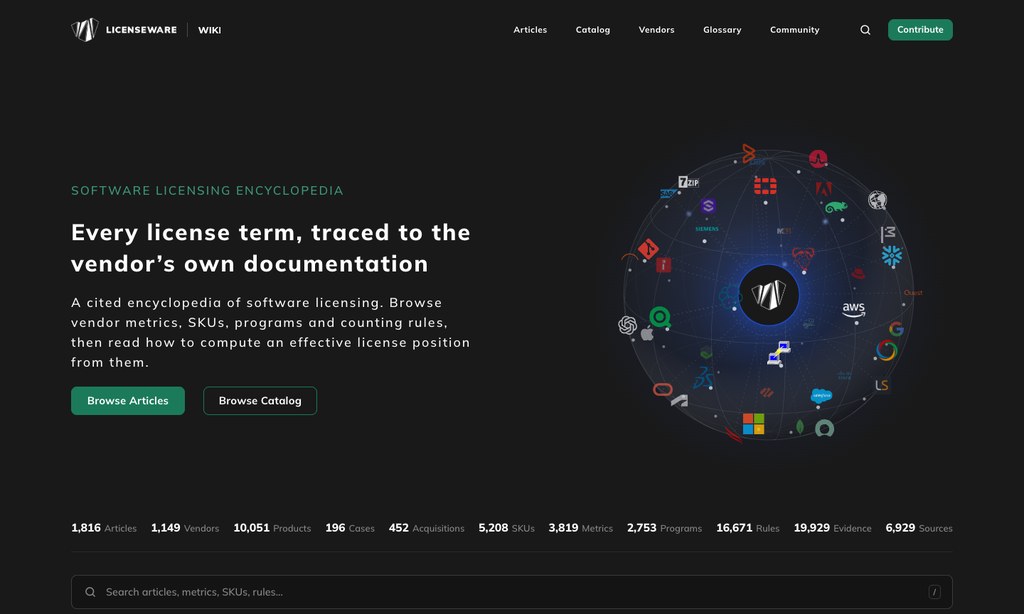
What is inside at launch
- 1,816 articles covering 1,149 vendors and 10,051 products.
- 3,819 license metrics and 16,671 counting and prerequisite rules.
- 5,208 SKUs and 2,753 licensing programs, with 452 vendor acquisitions tracked.
- 196 litigation cases on audits and licensing disputes, each linked to the court record, with what license managers can learn from them.
- A dedicated section on AI licensing: how products such as ChatGPT, Claude and Microsoft 365 Copilot are licensed.
- 19,929 evidence items drawn from 6,929 sources.
Every fact traced to the vendor
A licensing answer is only as good as the document behind it. Every rule in the wiki quotes the vendor's own wording and names the document it comes from, with the date it took effect, so you can check it yourself before you rely on it. The house rules set out what counts as a fact, which vendor documents are allowed as sources, and the section template every article follows.
That structure is what makes the wiki more than a set of articles. The catalog breaks each vendor's licensing into metrics, SKUs, programs and rules you can browse and search on their own: the Processor and Named User Plus metrics in Oracle Database licensing, for example, or the rule that an Authorized Outsourcer under Microsoft's terms cannot be a Listed Provider.
Where to start
- New to the field? The glossary and the article on the effective license position explain how entitlements, deployments, true-ups and audits fit together.
- Working on a vendor? Start from its article and follow the links into its metrics and counting rules.
- Buying AI? The AI section covers seat add-ons, token metering, committed capacity and open-weight model licenses, starting with OpenAI, Anthropic Claude and Microsoft 365 Copilot.
- Preparing for an audit? The litigation cases show how real disputes over audits, license scope, support and resale were decided.
- Planning upgrades? End-of-support dates and the licensing news feed show what is changing and when.
Help us build it
If this proves useful to the SAM and ITAM community, and maybe to everyone who buys software, we will keep expanding it until it covers virtually every software product out there. Contributions open soon: you can join the contributor waiting list today, and suggest a correction any time, with the vendor document that shows the right wording.
Explore it at wiki.licenseware.io, tell us what you would like to see in there, and become part of it. And when you want those rules applied to your own estate, that is what the LICENSEWARE apps do: book a call with our team.