
Why a VMware Support List Is Not a License Position
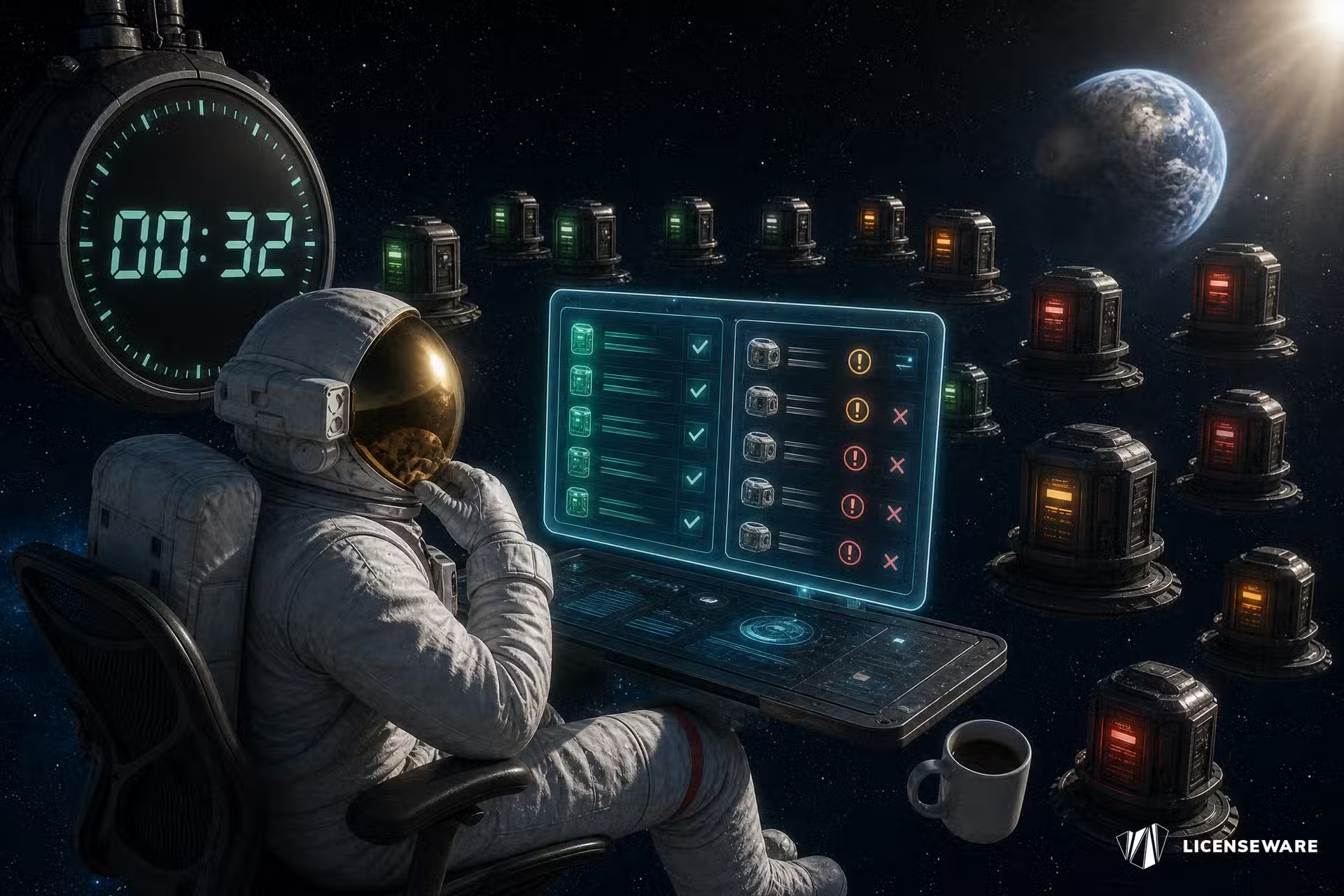
The VMware–Siemens fight started with a list. In September 2024 Siemens sent VMware products for which it wanted extended support. VMware says that list showed deployments that far exceeded the licenses Siemens had purchased. Siemens later sent an amended list. VMware asked for a license audit. Siemens would not participate. Siemens says it was entitled to the support, and that the Master Software License Agreement puts disputes in German courts. On 10 February 2026, Magistrate Judge Laura D. Hatcher of the District of Delaware recommended denying the move to Germany.
That’s the problem.
The parent pack is the VMware Broadcom stay vs exit page: perpetual versus VCF, the support path, portable VCF on AVS, and third-party cover.
This is not a courthouse story. It is what happens when the list you send for support and the licenses you can prove are two different files (and when the audit request arrives before you have reconciled them). If that feels familiar, the problem is not your team’s maturity. The problem is that a support request is being treated as a license position.
What the Delaware file actually says
VMware LLC v. Siemens AG, C.A. No. 25-353-RGA-LDH, was filed on 21 March 2025 (the same VMware lawsuit against Siemens that was already a reminder to get the licensing file in order before anyone sent a support list). The complaint asserts direct, contributory, and vicarious copyright infringement under the US Copyright Act, not a simple invoice dispute.
The 2012 Master Software License Agreement, later supplemented in 2021, authorized Siemens and affiliates to use specified VMware products and receive related support. VMware’s allegation is that the 9 September 2024 support list revealed unlicensed downloads through US-based servers. Siemens retracted that list on 29 October 2024 and sent a revised one. VMware treated the first file as evidence.
Judge Hatcher’s 10 February 2026 Report and Recommendation is not a verdict on the licenses. It recommended denying the move to Germany, dismissing Siemens AG for lack of personal jurisdiction, and keeping the copyright claims alive. US Siemens affiliates remain in the case. Objections were capped at ten pages.
Four facts, none of them a finding of non-compliance. A support list. An amended list. An audit that did not happen. A forum fight that stayed in Delaware.
Two lists, not one courthouse
Look at your own VMware file. Most SAM teams can produce a list of products they want covered. Fewer can produce, this week, a line-by-line match between that list and current entitlement. Those are different documents. One is a request. The other is a position.
You do not need a view on either party’s case to see the operational failure. The first list went out before the two files agreed.
This is not a criticism of the teams who assemble support requests. Those lists come from CMDBs, reseller quotes, last year’s true-up, and whatever the portal still shows as in use. They were built to get coverage, not to survive a license-by-license comparison. The gap is not missing data. The gap is that nothing turned the two lists into one defensible position before anyone hit send.
Picture your procurement lead, two weeks from a VMware conversation. The vendor has your support request. You have an inventory export. Legal has the forum clause. Your CIO wants to know whether you can claim the support, whether an audit is coming, and what number walks into the room if the lists do not match. If that answer takes three weeks of specialist reading, you have already lost the framing of the meeting.
An analysis that arrives after the vendor has framed the meeting is a document. One that arrives during the meeting is a decision input.
Audit refusal is a fact the next meeting will read
VMware says Siemens would not participate in a license audit. Siemens’ grievance runs the other way: VMware would not honor a support right Siemens believed it had. Both statements can sit in the same file. Neither one is a license position.
Refusing an audit is a legal and commercial choice. It is also a fact that travels. If you cannot produce a current, defensible match between what you run and what you are entitled to, a refusal does not create that match. It delays the comparison. In this case, the comparison is now a US copyright proceeding rather than a private review.
Traditional SAM tools collect comprehensively and answer slowly. They were built to prove completeness, not to tell you, this week, whether the SKU on the support list is a SKU you can prove. Insight latency is expensive here. Do not read an audit letter as a request for more reporting. Read it as a request for a position you should have been able to produce when you asked for the support. Audit pressure is what surfaces the gap the dashboards were already hiding.
Forum clauses do not erase where the software runs
Siemens argued that the MSLA’s forum selection clause required claims “arising out of” the agreement to be brought in Munich. That is a real clause, and plenty of enterprise paper has one. VMware’s counter was not to ignore the contract. It was that the claims are statutory copyright claims that exist independently of the MSLA, and that the alleged unlicensed use ran through US servers.
Judge Hatcher recommended denying the move to Germany. The clause used “arising out of,” which the court treated as narrower than “regarding.” Siemens had not clearly pleaded the MSLA as an affirmative defense. That is an early procedural outcome, not a finding that Siemens is out of compliance. If your operating assumption is that a European forum clause will keep a US-use dispute out of a US court, test that assumption against where the software actually runs (and against the exact words in the clause).
For SAM, the jurisdiction point is practical. Your license position has a geography. The court recommended dismissing Siemens AG, the German parent, while leaving the US affiliates in. If you cannot say this week which legal entity runs the software, which paper covers that entity, and where the instances sit, you do not have a forum strategy. You have a hope.
What to reconcile before you claim extended support
Do this before the next support request or audit letter leaves the building. A decision pack, not a project.
| Before you send or refuse | What you reconcile | Why it changes the meeting |
|---|---|---|
| The extended-support list | Every product on the request matched to current entitlement, not last year’s PO or a CMDB nickname | VMware treated Siemens’ first list as evidence of unlicensed use. The first file is the one that started the fight. |
| “We are entitled to support” | The clause, the term, and the products it actually covers | Belief is not paper. The MSLA, the ELA, and the support SKU list have to agree. |
| An audit request | A written position you could produce if you sat the audit | A refusal does not invent the missing match. |
| “This dispute belongs elsewhere” | Where the software runs, which entity uses it, and what the contract actually says about that use | Delaware kept the case on a narrow “arising out of” clause and US-based alleged use. |
Can a non-specialist brief the CIO in fifteen minutes from the pack you have today? If the answer is no, you do not have a license position. You have two lists.
The decision layer, not another inventory
You already have discovery data, contracts, and a support spreadsheet. The gap is not another inventory. The gap is turning those files into a decision before you claim support or decline an audit: what is deployed, what you are entitled to, which support path the paper actually grants, and what should happen next. LICENSEWARE sits on the inventory and ITSM tools you already run. It is not a rip-and-replace SAM suite. It is a decision layer: what matters, why it matters now, what should happen next. Host topology from RVTools or vCenter already lands in the data sources you run; the work is matching the support list to that estate before anyone hits send.
If you are heading into a VMware audit or a support-extension conversation and your current tools still need three weeks to turn two lists into one position, book an Audit Readiness Review. You can also start on the free plan and run the analysis on your own data.
The question to walk in with
Do not let the vendor frame this as “you asked for support on software you do not own.” The right question, from your side of the table, is: what are we actually running, what does the contract still grant, which products are on the support list because they are licensed, and which are on it because someone needed a ticket closed? That is a data question, not a sales question.
The magistrate’s report is an early win for VMware on forum, not a finding on the licenses. You still have to run the estate.
The vendor will walk in with a number, or with your own list. The only question is whether you have yours first: current, defensible, and tied to the contract in front of you.


