Compare Software Vendors Side by Side on the LICENSEWARE Wiki

Ask two software vendors the same question and you get two answers in two different documents. What does the contract say about audits? How much notice, who pays, what happens when a shortfall is found? Each answer sits in a PDF with its own structure, its own defined terms and its own section numbers. Comparing them means opening both, finding the right clause and reading it twice.
The LICENSEWARE Wiki now does that reading side by side. Compare Vendors lines up two vendors across 31 licensing topics, and every rule on the page is cited to the vendor's own document. It is free to read.
How to use Compare
- Open wiki.licenseware.io/compare/.
- Pick a topic, or choose "Compare on every topic" to see all of them for the two vendors you select.
- Choose Vendor A and Vendor B from the searchable lists. Popular pairs are one click away, and once you pick one vendor the page suggests similar vendors to compare it with.
- Read the rule cards in two columns. Each column shows the first few rules; "Show all N rules" opens the rest. Copy the link to share the exact comparison.
A worked example: audit clauses
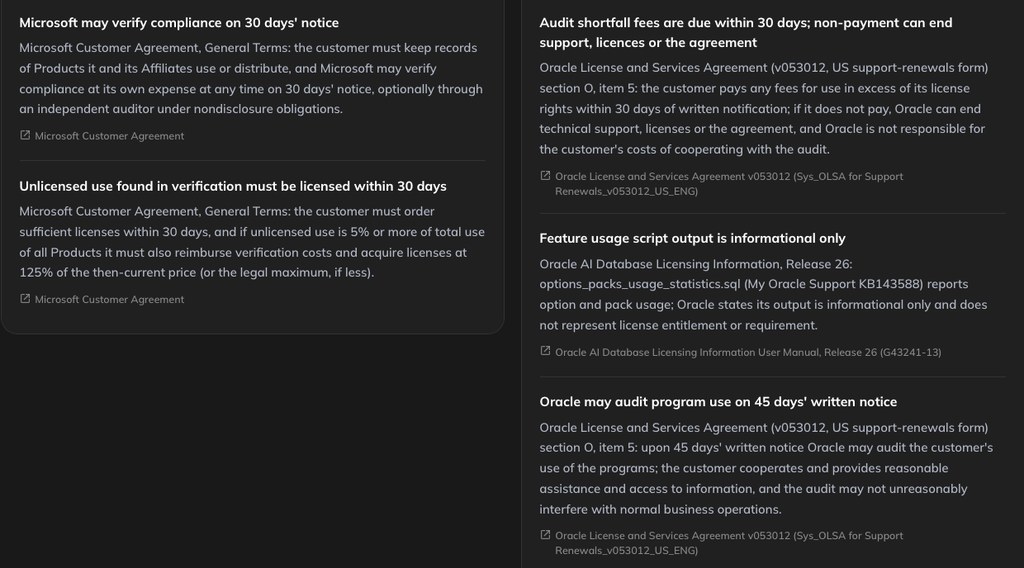
Take the audit clauses topic. It holds 634 cited rules across 338 vendors. Pick Microsoft and Oracle and the two columns show what each company's own documents say.
- Microsoft: under the Microsoft Customer Agreement, General Terms, the customer must keep records of the products it and its affiliates use or distribute, and Microsoft may verify compliance at its own expense at any time on 30 days' notice, optionally through an independent auditor under nondisclosure obligations.
- Oracle: under the Oracle License and Services Agreement, section O, item 5, Oracle may audit the customer's use of the programs on 45 days' written notice, and the customer pays any fees for use in excess of its license rights within 30 days of written notification.
That is what the documents say, nothing more. The page does not tell you which terms are better and it is not advice. It puts the two clauses where you can read them together, with the source named under each. For the wider context on how audits work, the wiki's article on software license audits is the place to start.
31 topics in three groups
The topics cover the questions that come up when you read a vendor's terms. They are grouped so you can find the one you need:
- Contract Terms: audit clauses, termination, renewal, support and liability terms, among others.
- Usage and Deployment: how and where the software may be used and deployed.
- Licence Metrics: how each vendor counts what you use.
Choose one topic to go deep on a single question, or compare on every topic to see how two vendors differ across the whole agreement.
How rules are matched and reviewed
A rule appears under a topic when its wording fits that topic. The wiki also files rules under related labels, and those matches are reviewed for relevance. 2,138 off-topic wording matches were excluded, so a topic page shows rules about the topic and not every rule that happens to use the same words.
Read the columns with one caveat in mind. A shorter column means fewer recorded terms for that vendor on that topic, not that the vendor has none. In the example above Microsoft shows 2 rules and Oracle 3, which says how much the wiki has recorded and nothing about whose contract is more or less demanding.
What the page does not do
At the bottom of every comparison there is a disclaimer, and it is worth reading. The information is general, it is not legal or licensing advice, and you should check the cited sources before you rely on a rule. The wiki was researched with AI assistance, and the citations are there so that you can verify each rule yourself.
Where to go next
Which question do you keep answering from two different PDFs? Try it on the Compare page and check the result against the cited document. If you have not met the wiki yet, the post on the LICENSEWARE Wiki launch explains what it is and how every fact is sourced.